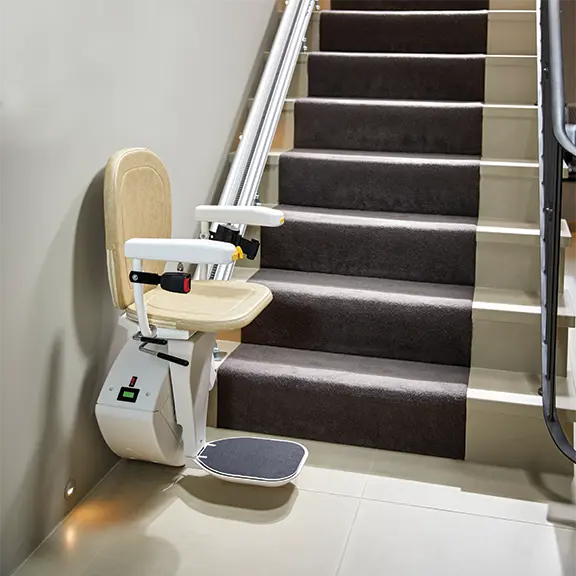
Fitting a stairlift can take a few hours, but the wait between ordering and installation is a separate matter. Before agreeing a date, check that it includes any preparation work, testing and time to learn how to use the lift.
A clear installation plan should tell you what will happen to your stairs, who is arranging the power supply and when the equipment will be ready to use.
Key takeaways
- Ask for both the expected fitting date and the time the engineer needs in your home.
- Confirm who will arrange and pay for any power point or other preparation work.
- Allow time to practise using the fitted lift with the engineer before the handover ends.
How long does stairlift installation take?
Ask for two timings: the expected wait from order to fitting, and the time the engineer needs in your home. A short fitting appointment does not mean a lift is available immediately.
For a named example, Stannah's UK FAQs describe fitting in a matter of hours. Acorn's installation page says its straight lifts can take as little as an hour to fit, and curved lifts a few hours. These are manufacturers' descriptions, checked on 7 November 2026; ask what time to allow for your own installation.
Preparation work, the rail arrangement and the handover all need to fit into the plan. Confirm when you can use the staircase again, particularly if it is your only route to a bedroom or bathroom.
The wait after ordering
The rail system matters as well as whether your stairs are straight or curved. A curved rail made in a factory and a modular rail assembled from sections have different production arrangements.
Stannah's UK timescale page, checked on 7 November 2026, lists 10 working days from order for Siena and Starla lifts with no turns. It describes around three weeks to manufacture the curved rails for those models with one or two turns, followed by fitting. The page concerns private domestic purchases from Stannah online; other purchase routes have different terms.
Acorn describes its FastTrack curved rail as a modular system and advertises next-day fitting in some cases. That is an availability claim to check for your address and proposed equipment, rather than a date you can assume when making an enquiry.
If you need the lift by a particular day, say so at the start. Ask when the date becomes firm, what work must happen first and who will contact you if the plan changes.
What needs doing to the stairs?
Stannah and Acorn both describe their domestic stairlifts as fixed to the stairs rather than the wall. The fixing points still matter: ask the surveyor to show where the rail supports will go and explain any changes needed around the staircase.
Stannah's buying process identifies possible preparation such as an extra power point or moving furniture or a radiator. A general claim of little disruption does not tell you whether your particular proposal needs additional work.
Battery operation does not remove the need for charging. Stannah says its lifts need an outlet at the top or bottom of the stairs and that it can arrange a power point as part of installation. Confirm the requirements for the model you are buying, who will do any electrical work and whether the cost is included.
If carpet replacement or decorating is already planned, discuss the order of work before booking. Do not move a radiator, alter a socket or change the staircase simply on the strength of a general online guide.
Our stairlift survey guide covers the assessment before ordering. For rail ends near doors and landing access, see narrow stairs and awkward doorways.
Before fitting day
Keep the agreed specification and quotation to hand. Check the arrival window, expected finishing time and whether the person who will use the lift needs to be present throughout or for the demonstration.
- Clear loose belongings from the stairs and the route the engineer will use.
- Confirm any agreed power point or other preparation is complete.
- Tell the company about access arrangements, parking restrictions or a change to the staircase since the survey.
- Arrange for a family member or carer to join the handover if that would help.
Leave technical work to the installer. If you have bought a used lift privately, establish who will assess and fit the exact equipment before arranging collection. Our reconditioned stairlift guide explains why a used unit and a supplied-and-installed package can involve different responsibilities.
Before the engineer leaves
Acorn describes testing the fitted lift before demonstrating it. Allow time for the handover in your own booking: a demonstration is your chance to practise with the equipment in its final position.
With the engineer guiding you, work through the parts you will use every day:
- Approaching the seat, getting on and off, fastening the belt and using the swivel.
- Operating the travel controls and any separate call controls.
- Folding the seat, arms and footrest, and using any hinged or moving rail fitted.
- Parking in the correct charging position and recognising the relevant indicators.
- Finding the instructions, support number and advice for a power cut or fault.
If something is difficult to reach or use, raise it there and then. Ask the installer to explain what happens next if a setting or part of the arrangement needs attention.
Keep the user manual, warranty and service information together. Our guides to charging and power cuts and servicing and breakdown cover cover the ongoing questions.
Get the complete installation price
Check that the written total covers the lift and rail specified, fitting, testing, demonstration and any agreed preparation. Ask which work is excluded and who will arrange it. Use our quotation comparison checklist alongside the main stairlift price guide.
You can request stairlift quotations to discuss suitable equipment and installation for your home. We may receive a payment from a partner following a successful recommendation. This does not increase the price you pay.