Swivel Seat
A manual or powered swivel seat turns towards the landing, making it easier and safer to get on and off the stairlift.
Straight Stairlift Guide
Discover everything you need to know about straight stairlifts, compare suitable suppliers and request free, no-obligation quotations with confidence.
Free Stairlift Quote
Free, no obligation and usually completed in under two minutes.
Understanding Straight Stairlifts
Straight stairlifts are designed for staircases that travel in one continuous line without bends, corners or intermediate landings. Because the rail does not need to be custom manufactured, they are typically quicker to install and usually cost less than a curved stairlift.
The rail is fixed directly to your staircase rather than the wall, allowing installation with minimal disruption to your home. Most straight stairlifts are powered from a standard household electrical supply and include rechargeable batteries, allowing them to continue operating during a power cut.
If your staircase changes direction, has a corner or includes a landing, you'll normally require a curved stairlift instead. If you're unsure which type is most suitable, requesting a free quotation is the easiest way to receive independent expert guidance.
Professional Installation
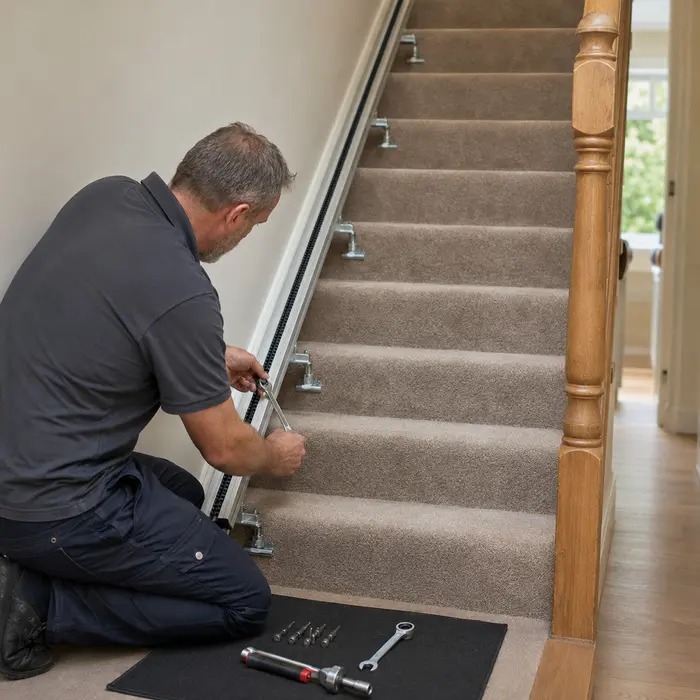
Installing a straight stairlift is usually straightforward because the rail is designed for a staircase that travels in one continuous line. The rail is fixed directly to the staircase rather than the wall, helping to minimise disruption during installation.
Most straight stairlifts can normally be installed within two to three hours by experienced engineers. Some suppliers may even offer next-day installation for suitable straight stairlifts, depending on availability and location.
During installation, the engineer will securely fix the rail using four or five stair brackets (sometimes referred to as cleats), fit the stairlift carriage and seat, test all safety features and demonstrate how to operate the stairlift before leaving your home.
Standard Features
Most new straight stairlifts include many features as standard, helping to make every journey safer, more comfortable and easier to use. Exact specifications vary between manufacturers and models.
A manual or powered swivel seat turns towards the landing, making it easier and safer to get on and off the stairlift.
The seat, arms and footrest fold neatly away when the stairlift is not in use, helping to maximise the available staircase width.
Built-in safety sensors automatically stop the stairlift if an obstruction is detected on the staircase.
Rechargeable batteries allow the stairlift to continue operating even during a power cut, provided the batteries are adequately charged.
Remote controls allow you to call or send the stairlift between floors when it is not being used.
Every journey should be completed with the seat belt securely fastened for additional safety and peace of mind.
Specialist Options
Some users and staircases require a more specialised solution. Suitable options may include perch seats, higher weight capacities and stairlifts designed for outdoor use.
A perch seat allows the user to travel in a more upright position. It may suit people who find bending their knees difficult or where the staircase is too narrow for a conventional seated position.
Selected straight stairlifts are available with wider seats, reinforced components and increased weight capacities. The available specification varies between manufacturers and models.
Outdoor straight stairlifts are designed to withstand changing weather conditions and are normally supplied with weather-resistant components and a protective cover.
Frequently Asked Questions
Find answers to common questions about straight stairlift suitability, features, installation, prices, safety and ongoing maintenance.
A straight stairlift is a mobility solution designed to help people travel safely and comfortably between floors on a staircase that runs in one straight line, without bends, corners or intermediate landings.
A straight stairlift uses a motorised carriage and seat that travel along a rail fixed directly to the staircase. The user normally operates the stairlift using a constant-pressure control on the armrest, while remote controls allow the stairlift to be called or sent between floors.
Common features include a comfortable folding seat, folding arms and footrest, a swivel seat, seat belt, obstruction sensors, rechargeable battery operation and remote controls. Exact features and specifications vary between manufacturers and models.
Straight stairlifts are designed for staircases without bends, turns or intermediate landings. If the staircase changes direction or travels around a corner, a curved stairlift will normally be required instead.
Straight stairlift prices vary according to the supplier, model, staircase measurements and any optional features required. Basic new straight stairlifts may start at around £2,000 to £3,000, while powered options, specialist tracks and other upgrades can increase the final price.
Straight stairlifts are generally straightforward to maintain. Regular servicing is recommended to help keep the stairlift operating smoothly and safely, while any unusual noises, warning displays or changes in performance should be investigated promptly.
A standard straight stairlift installation normally takes around two to three hours. The exact time depends on the staircase, the stairlift model and whether additional features such as a hinged or slide track are required.
New straight stairlifts are normally supplied with at least a 12-month warranty, although the precise cover varies between manufacturers and suppliers. Always check what is included, how long the warranty lasts and whether extended cover is available.
Common safety features include obstruction sensors, a seat belt, a swivel seat that locks securely into position and rechargeable battery operation. Some models also include an emergency stop control or additional diagnostic and safety features.
Many modern straight stairlifts are designed to fold compactly when not in use. For particularly narrow staircases, a perch seat may allow the user to travel in a more upright position where a conventional seated stairlift is unsuitable.
The right straight stairlift depends on the staircase measurements, available space, the user’s mobility needs, preferred features and budget. A professional assessment or home survey can identify suitable models and any specialist options that may be required.
Ready to compare straight stairlifts?
Tell us about your staircase and requirements, and we will help connect you with suitable stairlift suppliers covering your area.