A stairlift can make an important difference when using the stairs has become difficult or unsafe, but help with the cost is not automatic. Financial support may be available when a stairlift is assessed as a necessary and appropriate home adaptation. The scheme, assessment process and organisation responsible depend on where you live in the UK.
This guide explains the main public funding routes, what eligibility usually depends on and what to do before arranging an installation. It also covers possible alternatives when a grant does not meet the full cost.
Key Takeaways
A stairlift may be included within publicly funded home adaptations, but approval is based on assessed need and the rules of the relevant scheme.
Disabled Facilities Grants operate in England, Wales and Northern Ireland. Scotland has different arrangements for equipment and adaptations.
Adult grant applications are commonly means-tested, so an applicant may receive full funding, a contribution or no financial award.
An occupational therapist or another trained assessor may consider whether a stairlift is necessary and whether it is the most suitable solution.
Do not order a stairlift or allow work to begin until the funding body has confirmed what it will approve.
What Is a Stairlift Grant?
There is no single UK-wide scheme called a “stairlift grant”. The term is commonly used to describe financial help provided through home-adaptation schemes. A stairlift may be one of the adaptations considered when a disabled person needs better access to rooms and essential facilities within their home.
The best-known route is the Disabled Facilities Grant. It is available in England, Wales and Northern Ireland, although Northern Ireland applications are handled by the Northern Ireland Housing Executive rather than a local council. Scotland does not use the Disabled Facilities Grant system and has separate local arrangements for equipment and home adaptations.
Funding is not awarded simply because someone would find a stairlift useful. The relevant authority must be satisfied that the proposed work meets the scheme’s requirements. This normally includes considering the person’s needs, the suitability of the proposed adaptation and whether the work is reasonable for the property.
Stairlift Funding Routes Across the UK
The correct starting point depends on where the property is located:
England: contact the adult social care or housing adaptations service at your local council and ask about a Disabled Facilities Grant or any local discretionary assistance.
Wales: contact your local authority about a Disabled Facilities Grant and any additional home-adaptation schemes available in your area.
Scotland: contact your local council’s social work or housing service for an assessment and information about local equipment and adaptation support. The Disabled Facilities Grant does not operate in Scotland.
Northern Ireland: contact the Northern Ireland Housing Executive. A Disabled Facilities Grant is based on an occupational therapist’s recommendation and applies to eligible adaptations in private-sector homes.
Housing tenure can affect the route. Homeowners, private tenants and landlords may be able to apply under the relevant rules. Council or housing-association tenants may instead be directed to their landlord’s adaptations service. Tenants should obtain any permission required before work is arranged.
Local authorities may also operate discretionary schemes alongside their main statutory arrangements. Availability and conditions vary, so advice from one council area should not be assumed to apply in another.
Who May Be Eligible for Help?
Eligibility is not determined by age alone. A person may be considered when a disability, health condition or age-related need makes access within the home difficult and an adaptation could help them use the property more safely or independently.
For a Disabled Facilities Grant, the authority must be satisfied that the work is necessary and appropriate for the disabled person and reasonable and practicable for the property. The applicant must also meet the scheme’s occupancy and property requirements. An owner, tenant or landlord may be able to submit an application where a disabled person lives in the home.
An adult application is usually financially assessed. Household income and savings can affect whether the scheme covers the approved cost in full or whether the applicant must contribute. The rules include exceptions; for example, GOV.UK states that adaptations for disabled children under 18 are not assessed using their parents’ income. Applicants should obtain an individual calculation rather than assume that they will or will not qualify.
The assessment may also consider alternatives. If a different adaptation, a change to the layout or rehousing would meet the need more appropriately, funding for a stairlift may not be recommended.
How to Apply for Stairlift Funding
Contact the correct service. Approach your local council in England or Wales, your local council in Scotland, or the Northern Ireland Housing Executive in Northern Ireland. If you rent from a council or housing association, contact your landlord as well.
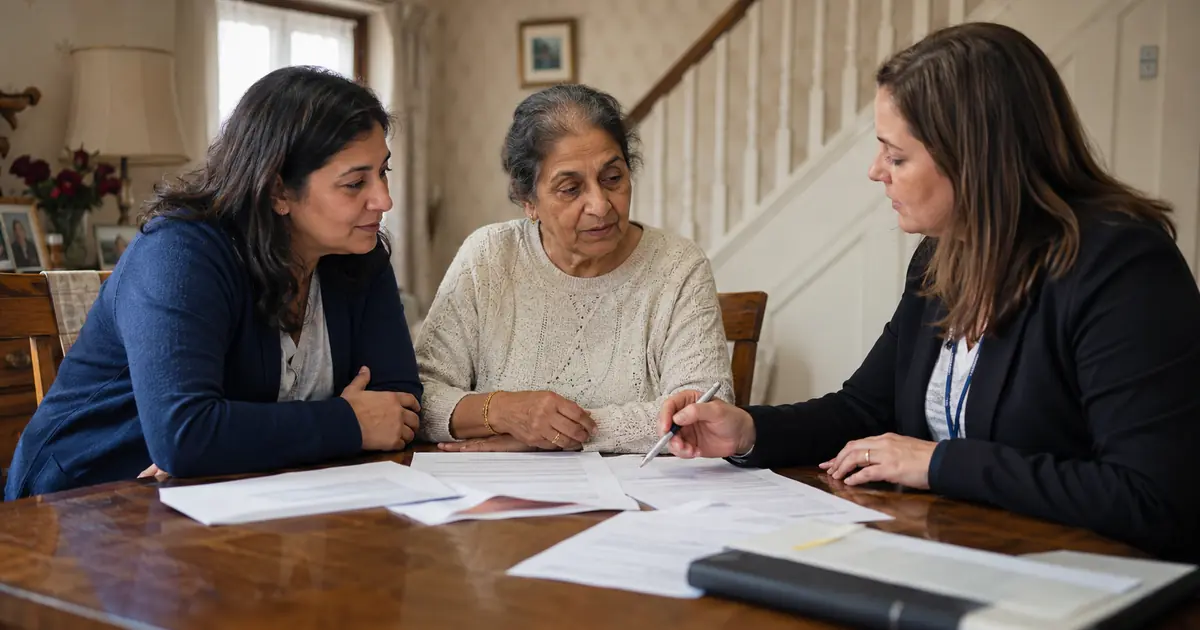
Request a needs assessment. An occupational therapist or another trained assessor may visit the home, discuss the difficulties being experienced and consider suitable ways to meet them.
Complete the application. You may be asked for information about the property, who lives there, ownership or tenancy, income, savings and benefits. Provide complete and accurate evidence to avoid unnecessary delays.
Allow the proposed work to be assessed. The authority may need specifications, quotations or further information to decide whether the stairlift and its cost are eligible.
Wait for written approval. Do not place an order, pay a non-refundable deposit or begin installation until the authority has confirmed its decision and explained any contribution you must make.
A recommendation from an occupational therapist supports the assessment of need, but it is not by itself a promise that a grant will be awarded. The funding body must still consider the full application under its rules.
Before Ordering a Stairlift
If you are seeking public funding, speak to the relevant authority before committing to a supplier. GOV.UK warns that an applicant might not receive a Disabled Facilities Grant if work starts before the council approves the application.
Ask the funding body to confirm:
whether a formal assessment is required;
which costs can be considered;
whether it will obtain quotations or expects you to do so;
whether you must use an approved contractor;
how much, if anything, you are expected to contribute;
who will own and maintain the stairlift; and
what happens if the stairlift is no longer needed.
If the need is urgent, explain this when making contact. An urgent situation does not remove the need for approval, but the service can tell you whether a faster assessment or another form of support is available.
What If a Grant Does Not Cover the Full Cost?
A financial assessment may result in a required contribution, or the proposed stairlift may not qualify under the relevant scheme. Before deciding how to proceed, ask for the decision and calculation in writing and check whether the authority has an appeal, review or complaints process.
Possible alternatives include:
asking whether the council or housing provider offers discretionary assistance;
considering a suitable reconditioned stairlift where appropriate;
asking suppliers about rental where the need is expected to be temporary and the staircase is suitable;
using personal savings or help freely offered by family; or
considering credit only after checking the total repayable amount, interest, fees and affordability.
These are options rather than recommendations for every household. A stairlift should be suitable for the user and staircase, and any financial arrangement should be understood before an agreement is signed.
Can a Charity Help With the Cost?
Some charities and benevolent funds consider applications for disability equipment or home adaptations. Support may be linked to a particular occupation, trade, military service, medical condition, location or personal circumstance.
Charitable funding is discretionary and is not routinely available to everyone. Funds may be limited, applications can take time and an organisation may ask whether statutory funding has been explored first. Check the charity’s current eligibility rules directly and never pay an organisation merely for access to a grant application.
A local Home Improvement Agency, welfare-rights adviser, Citizens Advice service or social care team may be able to identify reputable organisations relevant to your circumstances. They cannot guarantee an award.
Common Causes of Delay or Refusal
Applications can be delayed when financial evidence, tenancy information, property permissions or requested quotations are missing. Responding promptly and keeping copies of documents and correspondence can help the process move forward.
An application may be refused, or a different solution proposed, if the authority decides that:
the work is not necessary and appropriate to meet the assessed need;
the proposed installation is not reasonable or practicable for the property;
another solution would meet the need more effectively;
the applicant does not meet the scheme’s property or occupancy conditions; or
the financial assessment means no grant is payable.
If you disagree with a decision, ask for the reasons in writing and use the review, appeal or complaints route explained by the relevant authority. A supplier cannot overturn a public body’s funding decision.
Where to Find Reliable Information
Use official sources for the current rules and application route:
GOV.UK Disabled Facilities Grants guidance covers the main rules for England, Wales and Northern Ireland and links to the relevant application routes.
NHS home-adaptations guidance explains how to request a home assessment and where help with costs may be available.
Scottish Government equipment and adaptations guidance explains the Scottish approach.
nidirect Disabled Facilities Grant guidance explains the Northern Ireland route.
Scheme rules and local policies can change. Confirm the current position with the responsible authority before making a financial commitment.
What to Do Next
Begin with an assessment rather than a product order. Contact the relevant council, housing provider or Northern Ireland Housing Executive and explain which parts of the home are difficult to access. Ask specifically about home adaptations and financial assistance.
If a stairlift is recommended, obtain a clear specification and understand what the funding body will approve before comparing suppliers. If you are buying privately, compare like-for-like quotations, warranties, servicing arrangements and removal terms as well as the initial price.
Independent stairlift advice can help you understand the available types of stairlift, but only the responsible authority can decide whether public funding will be awarded in your case.
Frequently Asked Questions
Can you get a government grant for a stairlift?
Possibly. In England and Wales, a Disabled Facilities Grant from the local council may include a stairlift when it is assessed as a necessary and appropriate adaptation. Northern Ireland has a Disabled Facilities Grant administered by the Northern Ireland Housing Executive. Scotland uses different local equipment and adaptations arrangements. Eligibility, financial assessment and approval rules apply, so funding is not guaranteed.
Can I get a stairlift completely free of charge?
A publicly funded scheme may cover the full approved cost for some applicants, but this depends on assessed need, eligibility, the financial assessment and the cost the authority agrees to fund. Other applicants may need to contribute or may receive no award. “Free stairlift” should not be treated as a separate scheme or a guaranteed outcome.
Can you get a free stairlift on the NHS?
You should not expect the NHS to purchase a domestic stairlift. Major home adaptations are normally considered through local authority, housing or social care arrangements. An NHS professional may help identify a mobility problem or refer you for an assessment, but that is separate from the funding decision.
Do I need an occupational therapist’s assessment?
A needs assessment is commonly part of the public-funding process, and it may be completed by an occupational therapist or another trained assessor. The precise route varies by nation, council, housing provider and individual case. If you are buying a stairlift privately, there is no government requirement to qualify, although a proper user and staircase assessment remains important.
Will my income and savings be considered?
For many adult Disabled Facilities Grant applications, yes. The financial assessment can affect how much the applicant must contribute. Different rules and exceptions apply in some cases, including adaptations for disabled children. Ask the relevant authority for an individual assessment rather than relying on a general estimate.
Can I order the stairlift while waiting for a decision?
Do not order the stairlift or begin installation unless the funding authority has confirmed in writing that you may proceed. Starting work before approval can prevent a Disabled Facilities Grant from being paid.