Bespoke is one of those words that can mean different things when you are looking at stairlifts. It may describe a made-to-measure rail for a curved staircase, a standard stairlift configured around its user, or the company called Bespoke Stairlifts.
Whichever meaning is intended, the important question is the same: does the proposed stairlift properly suit the person, the staircase and the space at each landing? This guide explains what can genuinely be tailored, what to expect from a survey and how to compare your options without being distracted by marketing language.
Key Takeaways
Curved stairlifts normally use a rail designed around the bends, angles and landings of one particular staircase
Straight stairlifts usually use a standard rail cut to the required length, although the seat and controls may still be tailored to the user
A good assessment considers safe transfers, posture, dexterity and the space left for other people using the stairs
Features and finishes vary between manufacturers, so never assume an advertised option is included as standard
Your written quotation should identify the model, equipment, installation, warranty and aftercare included in the price
What Is a Bespoke Stairlift?
On a curved staircase, the word usually refers to the rail. The staircase is measured and the rail is then designed to follow its particular route, including corners, changes of angle and intermediate landings. The survey also helps determine where the chair can start, finish and park without creating an unnecessary obstruction.
A simple straight flight is different. In most cases, it can take a standard straight rail cut to the correct length. The installer may still adjust the seat height and recommend suitable controls or folding features, but the rail itself does not normally need to be individually designed.
That distinction matters because a more heavily customised product is not automatically a better one. If a straightforward stairlift meets the user's needs safely, there is little value in paying for complexity that the home does not require.
Nor does bespoke mean that every installation is possible. Stair width, headroom, doors, radiators, landing space and the user's ability to transfer all affect what can be fitted safely. A home assessment and technical survey are therefore essential.
What Can Be Customised?
The available choices depend on the manufacturer and model. They may include alternative seat heights, manual or powered swivel seats, different control types, linked folding footrests, upholstery colours and rail finishes.
Some options are mainly practical. A powered swivel may help somebody who cannot easily turn the seat by hand. Linked folding parts may be useful if bending down is difficult. A hinged rail can keep a doorway or passage clear when the stairlift is not in use.
With a curved stairlift, the rail route is another important decision. Ask the surveyor to show you where the rail and chair will finish at both ends, where the chair will charge and how much space will remain for anyone walking on the stairs.
Colour and upholstery matter in a person's home, but comfort and safe use come first. The intended user should be able to operate the control, fasten the seat belt and get on and off with confidence. Make sure every agreed option—and any extra cost—is recorded in the quotation.
Bespoke Stairlifts: Infinity and Synergy
Bespoke Stairlifts Limited is a West Yorkshire manufacturer as well as a brand name. Its current range includes the Synergy for straight staircases and the made-to-measure Infinity for curved stairs. They are separate stairlift models; Synergy is not a feature or mechanism within the Infinity.
The company lists seat belts, obstacle sensors, remote controls, folding components and diagnostic displays among the features across its range. Exactly what is standard—and what costs extra—should be confirmed for the individual model and supplier.
Both models are battery-powered, with a mains supply used to keep the batteries charged. According to the manufacturer, Synergy charges continually along its straight rail, while Infinity uses charging points on the curved rail. The batteries therefore power normal use; they are not simply an emergency backup.
Bespoke Stairlifts states that its stairlifts travel at an average speed of 0.1 metres per second. It does not describe this as a speed the user can adjust. Check the current specification, weight limit, warranty and local aftercare arrangements before choosing either model.
How Can a Tailored Stairlift Help?
The benefit is usually quite practical: being able to reach a bedroom or bathroom without facing a difficult climb. A stairlift that suits the user's size, posture and movement may also make sitting down, travelling and getting off noticeably easier.
On stairs with bends, a rail made for the route can carry the chair around corners and across intermediate landings. Careful planning at the survey stage can also place the chair where there is enough room for a safer transfer.
A stairlift will not suit everybody. The user needs to travel in the intended seated or perch position, use the restraint and transfer safely. If those points are uncertain, advice from an occupational therapist or another appropriate healthcare professional can be useful alongside the supplier's technical assessment.
Be cautious of promises that any stairlift will “transform” a person's life. It can remove one important barrier within the home, but the likely benefit should be judged against that individual's circumstances rather than a generic success story.
Cost and Long-Term Value
There is no meaningful fixed price for every bespoke stairlift. The quotation will depend on the staircase, rail design, model, chosen options and any additional installation work. A made-to-measure curved rail will usually cost more than a rail for a simple straight flight because it has to be surveyed, designed and manufactured for that staircase.
Compare quotations on a like-for-like basis. A lower figure may exclude an option, a longer warranty or a level of aftercare included elsewhere. Ask each company to set out the equipment, installation and ongoing support clearly rather than relying on a headline price.
It is also worth asking about costs after the initial warranty, including servicing, call-outs and replacement batteries. If finance is offered, consider the interest rate, term and total amount repayable—not just the monthly payment.
Better access may be extremely valuable to the person living in the property, but a stairlift should not be sold as a guaranteed way to increase its resale value. Suitability, safety and the expected period of use are much better reasons for the decision.
From Survey to Installation
Although companies organise their work differently, the usual process has four main stages:
Assessment: the supplier discusses the user's mobility, transfers, preferred controls and any difficulties at the top or bottom of the stairs.
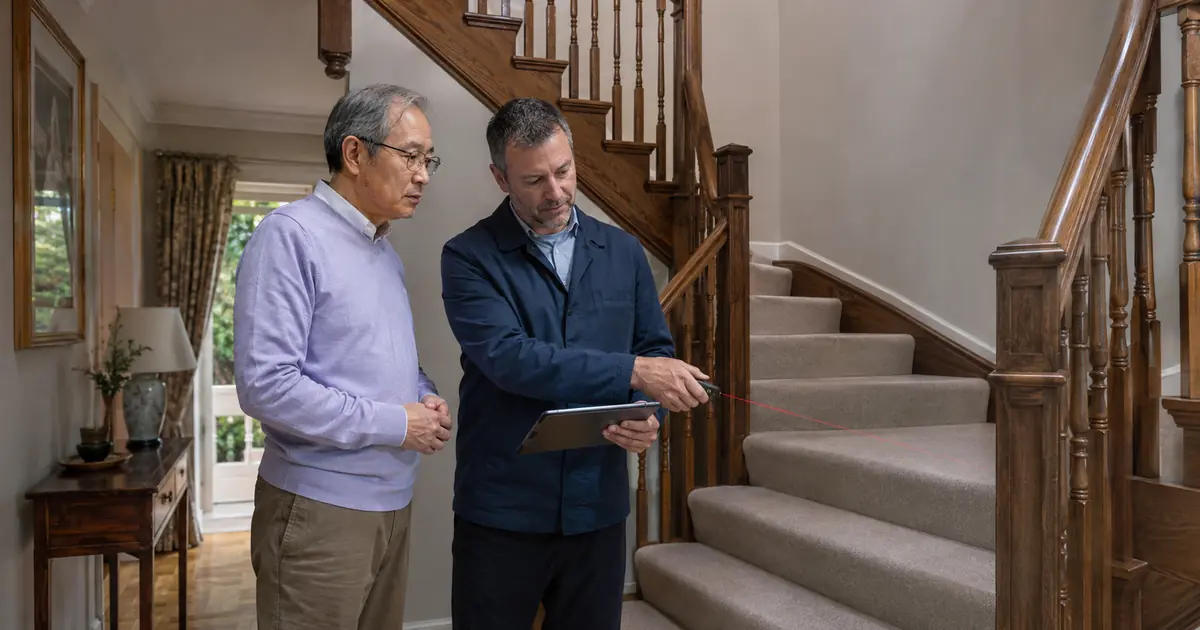
Technical survey: the staircase and landing areas are measured so the proposed model and rail route can be confirmed.
Written quotation: you review the equipment, options, price, warranty, estimated timescale and cancellation terms before ordering.
Installation and handover: the installer fits and tests the stairlift, then shows the user how to operate, charge and stop it safely.
The rail is normally fixed to the stair treads rather than the wall. Before the installer leaves, the user should be comfortable with the controls, seat belt, swivel seat, folding parts and the procedure to follow if the lift stops.
Bespoke Stairlifts currently advertises a free, no-obligation home assessment for its products. Do not assume that every company offers free surveys or the same manufacturing and installation times; confirm those details with the supplier you are considering.
Would a Straight Stairlift Be Enough?
If the staircase runs directly from one landing to the other without a bend or intermediate landing, a straight stairlift may be all that is required. The rail is simpler to produce, so straight models are often less expensive and quicker to supply than curved ones.
The choice is not based on the shape of the stairs alone. The surveyor still needs to check the width of the staircase, the user's knee clearance, transfer space, nearby doors and whether the chosen seat and controls are suitable.
If the lower end of the rail would cross a doorway or passage, a hinged or folding rail may be an option. Ask who will operate it and whether a manual or powered version is appropriate.
Straight stairlifts are mechanically less complex, but that does not guarantee that a particular model will need less maintenance. Follow the manufacturer's service guidance and check what the warranty requires.
Choosing the Right Seat
A comfortable-looking seat is not enough. Its height and width should suit the user, their feet should rest securely on the footplate and there must be enough space for their knees as the stairlift travels.
A swivel seat allows the user to turn away from the staircase before getting off at the upper landing. Depending on the model, it may work manually or at the touch of a button. Whichever type is proposed, the user needs to operate it reliably and recognise when it is locked in the travelling position.
Folding seats, arms and footrests can leave more room for people walking past the parked stairlift. Linked or powered folding features may help somebody who finds bending difficult, although they are not standard on every model.
Ask how the upholstery should be cleaned. Bespoke Stairlifts describes the covers on its Synergy and Infinity models as removable and easy to zip off for deeper cleaning, but it does not say they are machine-washable.
How to Compare Quotations
The clearest comparison comes from asking each company the same questions. In addition to the price, check:
the exact stairlift model and whether it is new or reconditioned
which features are included and which are optional extras
the proposed rail route, parking position and charging arrangement
who will install, service and repair the stairlift
what the warranty covers and what support is available outside normal working hours
the estimated delivery time, payment schedule and cancellation terms
Which Stairlift can help you compare suitable options and no-obligation quotations. Take your time with the written proposals and query anything that does not match what was discussed during the assessment.
Summary
A bespoke solution does not necessarily mean that every part of a stairlift is made from scratch. On curved stairs, the rail is normally designed for the individual staircase. On a straight flight, a standard rail may be entirely suitable, with the seat and controls chosen around the user.
The word is also part of the name Bespoke Stairlifts, whose Synergy and Infinity models serve straight and curved staircases respectively. In either case, a careful assessment, accurate survey and detailed quotation matter far more than broad claims about style, price or reliability.
Frequently Asked Questions
What is the most reliable stairlift brand?
There is no single brand independently proven to be the most reliable choice for every user and staircase. Look at the suitability of the proposed model, the warranty, local repair cover, parts availability and the supplying company's recent aftercare record. Ask for evidence behind any reliability claim.
Who owns Bespoke Stairlifts?
Bespoke Stairlifts Limited is an active UK private limited company, registered as company number 08406096. At the time of checking, Companies House listed Milbec & Son Limited and DWB Enterprises Limited as its two active corporate persons with significant control. Each was recorded as holding more than 25% but no more than 50% of the shares and voting rights. The current Companies House record should be checked if ownership is important to your decision.
Which is the best stairlift in the UK?
The best stairlift is the one that safely suits the user, staircase, landing space and budget—and comes with dependable installation and aftercare. No model can be judged on its brand name or list of features alone. A proper assessment and written comparison are more useful than a generic ranking.
What is the average cost of a stairlift in the UK?
An average cannot reliably predict the price for a particular home. Straight stairlifts on simple flights usually cost less than made-to-measure curved systems. Rail length, bends, parking position, model, optional features and installation work will all affect the quotation. Compare itemised prices based on a home survey and check exactly what each one includes.